Fascinating ~ Metallic Minerals
Metallic minerals captivate mineral specimen collectors with their striking luster, diverse formations, and even vibrant colors. Although some elements can indeed be found native in the earth, others must be synthesized or created in the lab in order to have the element in its pure form. These metallic elements typically occur on earth in conjunction with other elements, and rarley occur isolated.
Copper-based species like malachite showcase vivid banded green patterns from concentric growth, evoking swirling landscapes in polished slabs. Chrysocolla enchants with its turquoise-blue, botryoidal surface that glows like polished turquoise.
Magnesium
Magnesium is a rarity in mineralogy owing to its extreme chemical reactivity—it virtually never forms free in nature under terrestrial conditions—and authentic natural specimens are essentially nonexistent for collectors. What circulates as “magnesium” pieces are typically lab-created clusters, underscoring how this highly abundant crustal element (eighth most common) overwhelmingly exists in compounds like magnesite, dolomite, or carnallite rather than native form. These magnesium specimens can be stunning with their rare, feather-like silvery clusters.
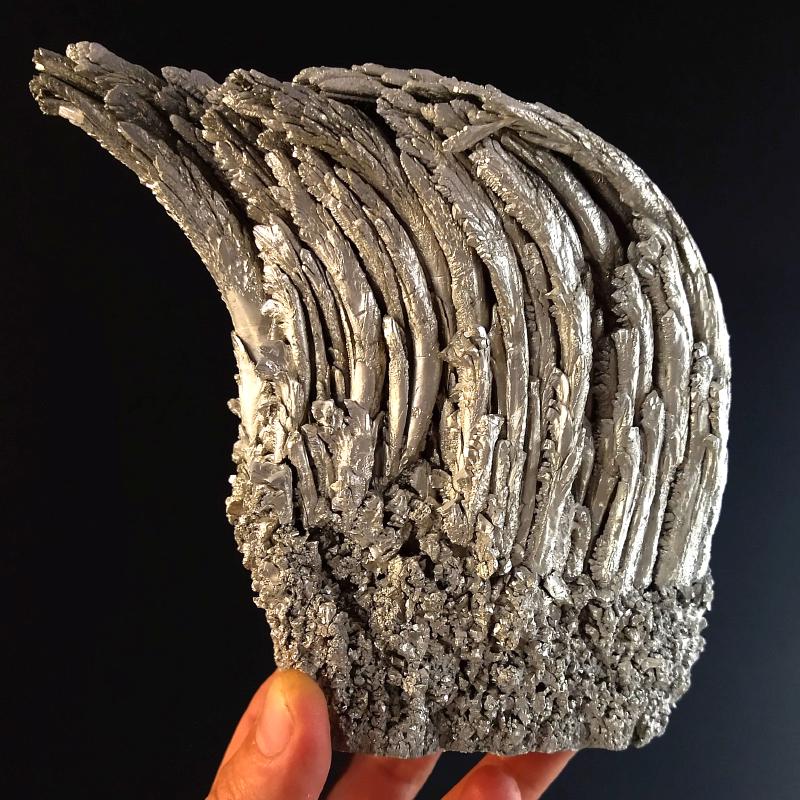
Magnesium is a metallic element that is element number 12 in the periodic table of the elements. It is an essential mineral in human metabolism. This is pure magnesium, grown in the labratory.
Iron Pyrite
Iron Pyrite is an iron sulfide mineral with the formula FeS₂—it is the most common sulfide mineral on Earth. Its name “pyrite” comes from the Greek word for fire (“pyr”), because striking it against steel or another hard surface produces sparks. Ancient civilizations used it as a fire-starting tool long before matches existed.
Pyrite crystals often form perfect geometric shapes, especially cubes, octahedrons, and pyritohedrons (12-faced dodecahedrons with pentagonal faces.) Our specimens come from Peru, China, and Spain.
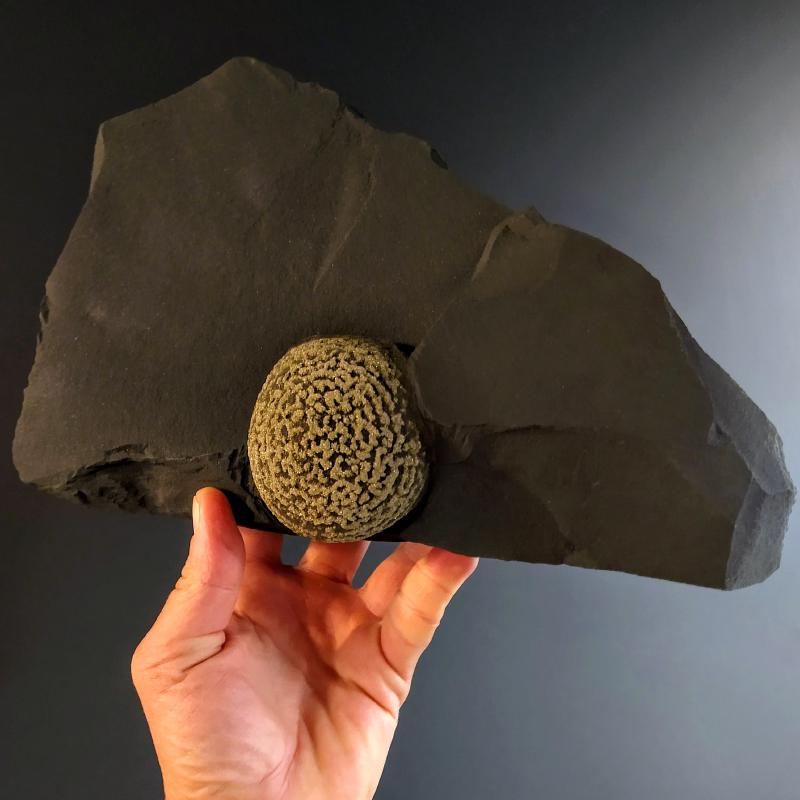
Chemical Composition: FeS2, Iron Disulfide, often with substantial amounts of nickel and cobalt
Hardness: 6 - 6 1/2
Occurrence: Brass-yellow in color, metallic, often tarnished with a film of iron oxide. Crystal formation varies, isometric in cubes and pyritohedrons, rarely as octohedrons. Also granular, massive, fibrous, stalactitic, and mammillary. Pyrite is found in many different rocks, and in hydrothermal veins. Localities in the U.S. include Utah, Illinois, Colorado, and Pennsylvania. Large amounts of Pyrite may be found in Peru, and stunning specimens can be found in Spain. Commonly known as “fool’s gold.”
Metaphysical Properties: Stone of protection. Wards off negative energy and physical danger. Stimulates intellect, enhances memory.
Corresponding Astrological sign: Leo Chakra: 3rd Chakra - Solar Plexus, represents physical perfection
Carborundum
Carborundum, synthetic silicon carbide (SiC), emerged as the first man-made mineral in 1891, when Edward Acheson accidentally synthesized it while attempting to produce artificial diamonds by heating carbon and silica. Exceedingly rare naturally, as the mineral moissanite, found only in trace quantities in certain meteorites, kimberlites, or impact craters. Lab-grown SiC exhibits unparalleled hardness (9–9.5 on the Mohs scale, second only to diamond) and striking iridescent colors.
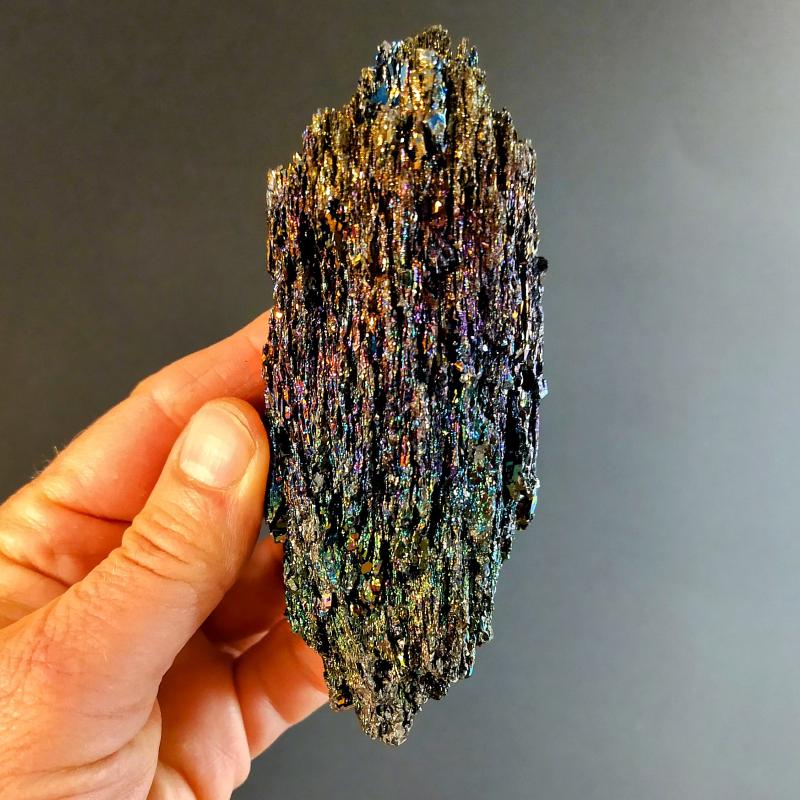
Carborundum is a ceramic compound of silicon and carbon. It occurs in nature as the extremely rare mineral Moissanite, only having been found in minute quantities in certain types of meteorite and in corundum deposits and kimberlite. Virtually all of the silicon carbide sold in the world, including moissanite jewels, is synthetic. Silicon carbide is a semiconductor. It is used in many applications, from LEDs, to lapidary, to the grip tape on skateboards, and in high performance brake discs. Collectors are attracted to this mineral for its attractive appearance. Silicon carbide (SiC)
Hematite
Hematite (Fe2O3) played a pivotal role in Earth’s history as a key component of banded iron formations, in massive layered deposits that formed around 2.4 billion years ago. When rising oxygen from early photosynthetic bacteria reacted with dissolved iron in ancient oceans, iron oxides resulted and fundamentally changed the planet’s atmosphere from oxygen-poor to oxygen-rich. Natural specimens of Hematite in botryoidal formation are the most attractive to mineral collectors, with their dark grey metallic lustre and “bubbly” appearance.
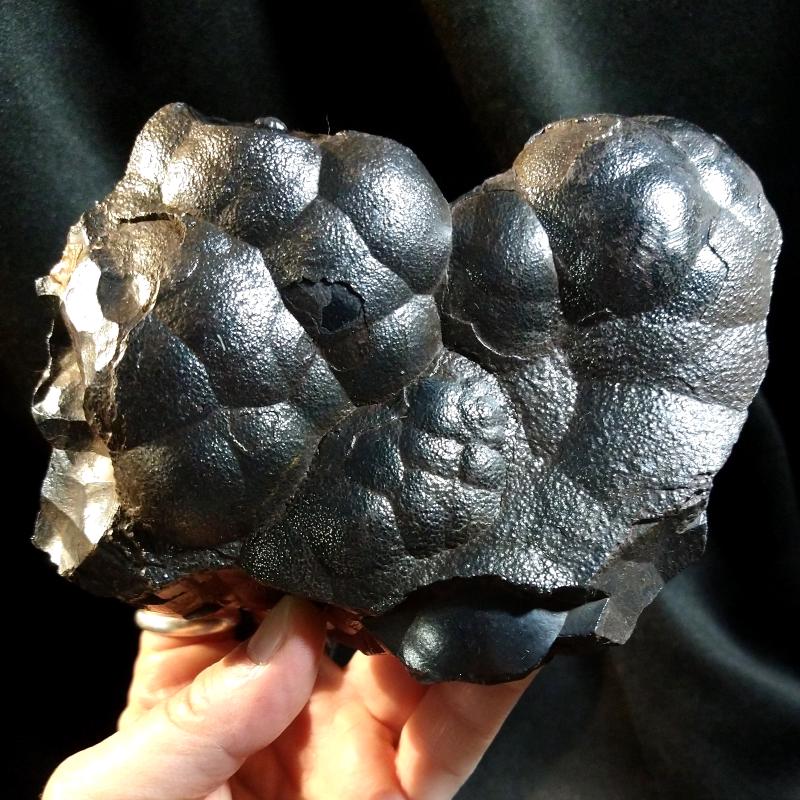
Chemical Composition: Hematite is composed of iron oxide (FeO2)
Hardness: 5-6
Metaphysical Properties: Hematite enhances mental activity. Balances yin/yang energies and emotions. Dissolves negativity. Grounding.
Corresponding Astrological signs: Aries and Aquarius
Chakra: 1st chakra, Root
Copper
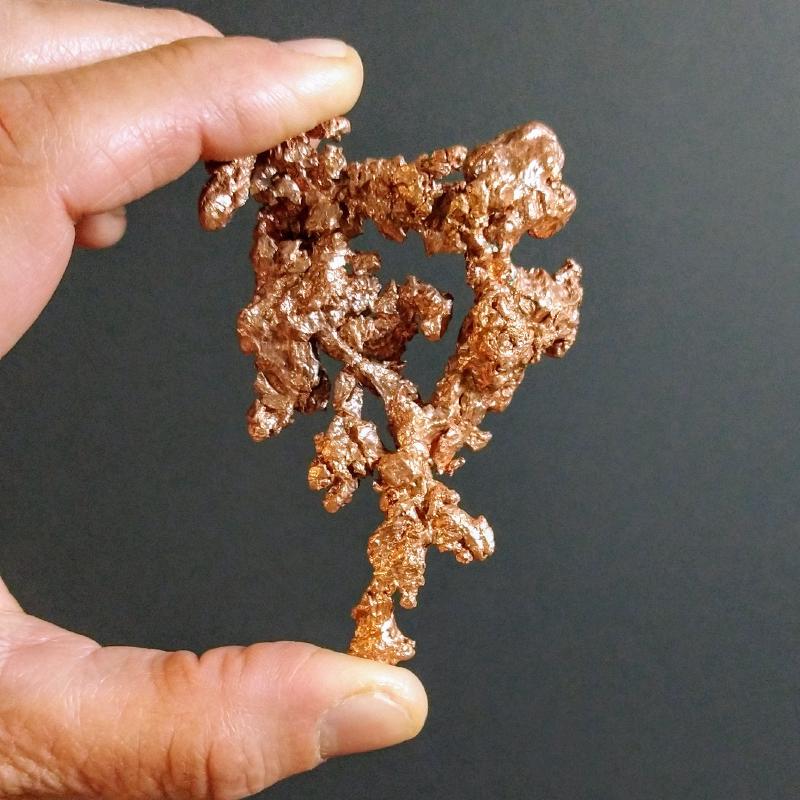
Copper is exceptionally uncommon in its pure, uncombined state. Most copper occurs in sulfide ores. The Keweenaw Peninsula in Michigan preserves the world’s premier deposits of native copper, forged roughly a billion years ago via hydrothermal activity within ancient lava flows.
It is humanity’s oldest worked metal, with evidence of use dating back over 10,000 years. Copper has exceptional electrical conductivity—second only to silver—but it is far more practical and cost-effective, which is why nearly all electrical wiring, motors, and circuits rely on copper.
Copper (and its alloy brass) is naturally antibacterial. It kills many microbes on contact, which is why hospitals often use copper doorknobs, railings, and surfaces to reduce infections. The Statue of Liberty alone contains about 179,000 pounds (81 tonnes) of copper sheets. Even gold jewelry usually contains a small amount of copper to make it harder and more durable.
Copper truly is one of the most historically and technologically important metals.
Silicon
Silicon is a metalloid (neither fully metal nor non-metal) with a shiny, bluish-gray appearance in pure form, but it only conducts electricity under specific conditions—making it the backbone of the entire semiconductor industry.
Silicon is the second most abundant element in Earth’s crust (about 27-28% by mass, after oxygen) and forms the basis of nearly all rocks, sand, clay, and soil through compounds like silicon dioxide (SiO2). But isolated silicon does not occur in nature – it must be extracted from silicon dioxide. This is the process by which silicon chips are made. Pure crystalline silicon has the same crystal structure as diamond (both form a cubic lattice), which is why ultra-pure silicon wafers look glassy and are incredibly precise for microchips. Silica, in this case sand, (SiO2) is purified to 99.9999%+ silicon, grown into massive single crystals via the Czochralski process, then sliced into those iconic thin wafers that power computers, phones, solar panels, and more. Silicon is largely responsible for our technological age. It is this lab-grown silicon that we feature in our collection on this site.
In 1969, Apollo 11 astronauts left a tiny silicon disc on the Moon—smaller than a silver dollar—etched microscopically with goodwill messages from 73 countries, a permanent “message in a bottle” from humanity.
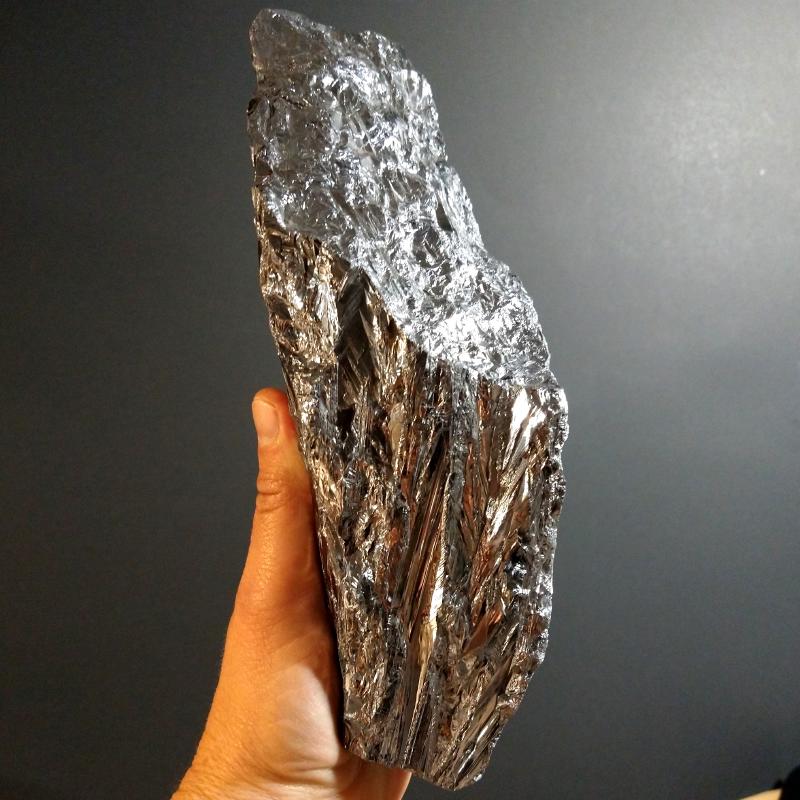
What makes computer technology possible? Silicon! Silicon does not exist in its pure form on earth, it must be refined from sand (SiO2). Then Silicon crystals are grown from a seed crystal in the lab, where it is heated to over 2,700 degrees fahrenheit.